
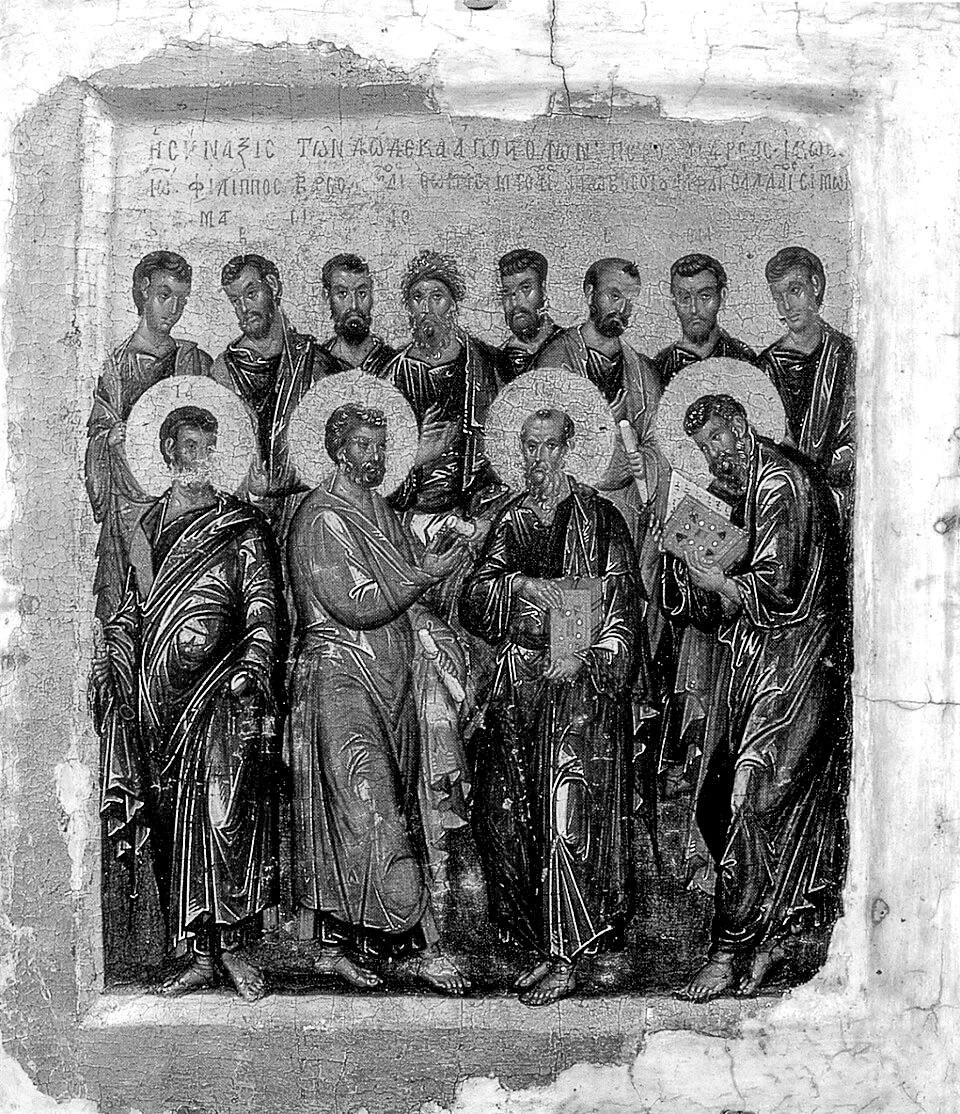
My child, him that speaks to you the word of God remember night and day; and you shall honour him as the Lord; for in the place whence lordly rule is uttered, there is the Lord. And you shall seek out day by day the faces of the saints, in order that you may rest upon their words. You shall not long for division, but shall bring those who contend to peace.
The Didache is an early Christian text from the late 1st/early 2nd century. Its authorship is unknown, but it is a catechetical text for new converts. It teaches the basic ethical and spiritual teachings of the Christian faith. Perhaps unsurprisingly, the text’s ethical teachings focus heavily on the words of Christ in the Gospels, and much of the text also appears in Christ’s ethical teachings, particularly in the Sermon on the Mount accounts in Matthew and Luke.
You might notice that Christian opposition to abortion is found in the Didache. Some have characterized the pro-life movement as a recent or politically motivated movement. It’s worth noting that Christians have always stood on the side of life from the very beginning of the Church universal, in keeping with the teaching of Christ and the Apostles.
NOTE: This rendering of the text is taken from “New Advent.. To read more, scan the QR code.
AN EXCERPT FROM THE DIDACHE
There are two ways, one of life and one of death; but a great difference between the two ways. The way of life, then, is this: First, you shall love God who made you; second, your neighbour as yourself; and all things whatsoever you would [wish] should not occur to you, do not also do to another. And of these sayings the teaching is this: Bless those who curse you, and pray for your enemies, and fast for those who persecute you. For what reward is there, if you love those who love you? Do not also the Gentiles do the same? But love those who hate you, and you shall not have an enemy. Abstain from fleshly and worldly lusts. If someone gives you a blow upon your right cheek, turn to him the other also, and you shall be perfect.
If someone impresses [upon] you for one mile, go with him two. If someone takes away your cloak, give him also your coat. If someone takes from you what is yours, ask it not back, for indeed you are not able. Give to every one that asks you, and ask it not back; for the Father wills that to all should be given of our own blessings (free gifts). Happy is he that gives according to the commandment; for he is guiltless. Woe to him that receives; for if one having need receives, he is guiltless; but he that receives not having need, shall pay the penalty, why he received and for what, and, coming into straits (confinement), he shall be examined concerning the things which he has done, and he shall not escape thence until he pay back the last farthing. Matthew 5:26. But also now concerning this, it has been said, “Let your alms sweat in your hands, until you know to whom you should give.”
And the second commandment of the Teaching: You shall not commit murder, you shall not commit adultery (Exodus 20:13-14), you shall not commit pederasty, you shall not commit fornication, you shall not steal (Exodus 20:15), you shall not practice magic, you shall not practice witchcraft, you shall not murder a child by abortion nor kill that which is begotten. You shall not covet the things of your neighbour (Exodus 20:17), you shall not forswear yourself (Matthew 5:34), you shall not bear false witness (Exodus 20:16), you shall not speak evil, you shall bear no grudge. You shall not be double-minded nor double-tongued; for to be double-tongued is a snare of death. Your speech shall not be false, nor empty, but fulfilled by deed. You shall not be covetous, nor rapacious, nor a hypocrite, nor evil disposed, nor haughty. You shall not take evil counsel against your neighbour. You shall not hate any man; but some you shall reprove, and concerning some you shall pray, and some you shall love more than your own life.
My child, flee from every evil thing, and from every likeness of it. Be not prone to anger, for anger leads the way to murder; neither jealous, nor quarrelsome, nor of hot temper; for out of all these murders are engendered. My child, be not a lustful one; for lust leads the way to fornication; neither a filthy talker, nor of lofty eye; for out of all these adulteries are engendered. My child, be not an observer of omens, since it leads the way to idolatry; neither an enchanter, nor an astrologer, nor a purifier, nor be willing to look at these things; for out of all these idolatry is engendered. My child, be not a liar, since a lie leads the way to theft; neither money-loving nor vainglorious, for out of all these thefts are engendered.
My child, be not a murmurer, since it leads the way to blasphemy; neither self-willed nor evil-minded, for out of all these blasphemies are engendered. But be meek, since the meek shall inherit the earth (Matthew 5:5). Be long-suffering and pitiful [showing pity] and guileless and gentle and good and always trembling at the words which you have heard. You shall not exalt yourself (Luke 18:14) nor give over-confidence to your soul. Your soul shall not be joined with lofty ones, but with just and lowly ones shall it have its intercourse [talks]. The workings that befall you receive as good, knowing that apart from God nothing comes to pass.
My child, him that speaks to you the word of God remember night and day; and you shall honour him as the Lord; for in the place whence lordly rule is uttered, there is the Lord. And you shall seek out day by day the faces of the saints, in order that you may rest upon their words. You shall not long for division, but shall bring those who contend to peace. You shall judge righteously, you shall not respect persons in reproving for transgressions. You shall not be undecided whether it shall be or no. Be not a stretcher forth of the hands to receive and a drawer of them back to give. If you have anything, through your hands you shall give ransom for your sins. You shall not hesitate to give, nor murmur when you give; for you shall know who is the good repayer of the hire. You shall not turn away from him that is in want, but you shall share all things with your brother, and shall not say that they are your own; for if you are partakers in that which is immortal, how much more in things which are mortal?
You shall not remove your hand from your son or from your daughter, but from their youth shall teach them the fear of God (Ephesians 6:4). You shall not enjoin anything in your bitterness upon your bondman or maidservant, who hope in the same God, lest ever they shall fear not God who is over both (Ephesians 6:9; Colossians 4:1). For he comes not to call according to the outward appearance, but unto them whom the Spirit has prepared. And you bondmen shall be subject to your masters as to a type [representative shadow] of God, in modesty and fear (Ephesians 6:5; Colossians 3:22). You shall hate all hypocrisy and everything which is not pleasing to the Lord. Forsake in no way the commandments of the Lord; but you shall keep what you have received, neither adding thereto nor taking away therefrom (Deuteronomy 12:32). In the church you shall acknowledge your transgressions, and you shall not come near for your prayer with an evil conscience. This is the way of life.
CONCLUSION
As I reflect upon this text, there is much to glean. Much of the text is taken one-for-one from the Gospels, with some from the Old Testament, but it also adds applications to that base that are worth reflecting on. These applications are things which the early Church was deeply concerned about, from abortion to parental discipline, to giving generously but wisely, to cultivating virtue in the ways we speak and act. These are also things we should consider in our own Christian walk two thousand years later, and I commend them to you as food for thought. May Christ illumine our steps as we walk together.
Daniel Liegmann