
Riches from the Past
NOVEMBER 2025
In our modern age, “new” is often associated with “better”. A new smartphone may have a more powerful camera. A new app may have an innovative way of making our lives more convenient. And a new AI may just become Skynet. One may say our culture has become obsessed with the new, the trendy, and the transient.
In that spirit, some people may ask why we read from a prayer book nearly 400 years old, often consisting of creeds, prayers, and psalms even older than that. That’s not very “new” or “modern” of us. But in a day when that high of chasing the new is starting to get old, we can stand firm in that which is transcendent. We, as Anglicans, respect and revere our forefathers in the faith. We have a rich, vibrant, and broad tradition to pull wisdom from. We recognize that we stand in a line of faithful people who have added beauty and edification to the church over the millennia.
But part of having such a vast tradition is… well, not even knowing where to start. That’s where I hope we here at Church of the Messiah can help. Every edition of this publication, Riches from the Past, will spotlight a particularly edifying sample of the work of a writer in church history. I will introduce these writers and briefly give context to their work and significance, and then I will let their work speak for itself. It is my prayer that this publication will spark a love for church history and the great men and women who God has used mightily to shape our faith. Let’s dig in!
INTRODUCTION: ST. IGNATIUS OF ANTIOCH
St. Ignatius of Antioch is what is known as an “Apostolic Father.” The Apostolic Fathers were part of that second generation of Christians who took the baton from the Apostles as the Apostles passed away. While they were not themselves Apostles, these Fathers had big shoes to fill, and they left behind a powerful legacy of faithfulness amid the challenges besetting the early church, including persecution and martyrdom. According to certain traditions, Ignatius may have known or been a disciple of St. John (yes, THAT John, who wrote the Gospel, Revelation, and the Epistles) himself and studied under him.
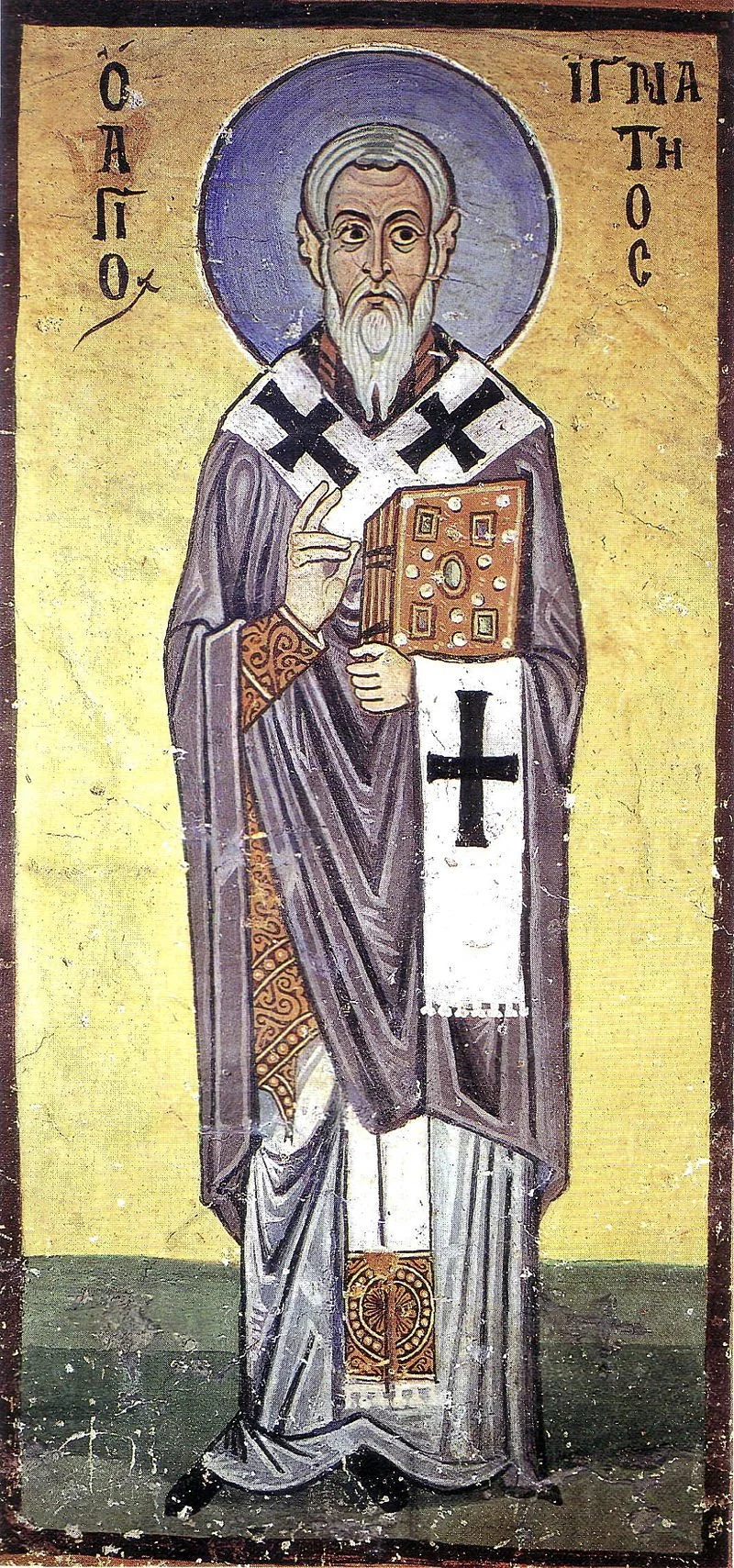
St. Ignatius of Antioch wrote some of the earliest Christian writings we have that aren’t in the New Testament. These writings, dated to the early 2nd century AD, contain reflections on church polity, the Incarnation, and the errors of the Docetists. The Docetists were an early heretical group that believed that Jesus Christ did not have a real, physical human body but rather only appeared to have one, because of their belief that physical creation itself was inherently evil and that only spirit is good.
But perhaps Ignatius’ most powerful reflection came in his Epistle to the Romans, not to be confused with St. Paul’s Epistle to the Romans. In this epistle, St. Ignatius is about to be martyred violently by animals in the Romans’ gladiatorial games, and he does not back down. In fact, he is more joyous than ever. Let’s have a look.
AN EXCERPT OF ST. IGNATIUS’ EPISTLE TO THE ROMANS
For it is not my desire to act towards you as a man-pleaser, but as pleasing God, even as also you please Him. For neither shall I ever have such [another] opportunity of attaining to God; nor will you, if you shall now be silent, ever be entitled to the honour of a better work. For if you are silent concerning me, I shall become God’s; but if you show your love to my flesh, I shall again have to run my race. Pray, then, do not seek to confer any greater favour upon me than that I be sacrificed to God while the altar is still prepared; that, being gathered together in love, you may sing praise to the Father, through Christ Jesus, that God has deemed me, the bishop of Syria, worthy to be sent for from the east unto the west. It is good to set from the world unto God, that I may rise again to Him.
You have never envied anyone; you have taught others. Now I desire that those things may be confirmed [by your conduct], which in your instructions you enjoin [on others]. Only request on my behalf both inward and outward strength, that I may not only speak, but [truly] will; and that I may not merely be called a Christian, but really be found to be one. For if I be truly found [a Christian], I may also be called one, and be then deemed faithful, when I shall no longer appear to the world. Nothing visible is eternal. For the things which are seen are temporal, but the things which are not seen are eternal. For our God, Jesus Christ, now that He is with the Father, is all the more revealed [in His glory]. Christianity is not a thing of silence only, but also of [manifest] greatness.
I write to the Churches, and impress on them all, that I shall willingly die for God, unless you hinder me. I beseech of you not to show an unseasonable goodwill towards me. Allow me to become food for the wild beasts, through whose instrumentality it will be granted me to attain to God. I am the wheat of God, and let me be ground by the teeth of the wild beasts, that I may be found the pure bread of Christ. Rather entice the wild beasts, that they may become my tomb, and may leave nothing of my body; so that when I have fallen asleep [in death], I may be no trouble to anyone. Then shall I truly be a disciple of Christ, when the world shall not see so much as my body. Entreat Christ for me, that by these instruments I may be found a sacrifice [to God]. I do not, as Peter and Paul, issue commandments unto you. They were apostles; I am but a condemned man: they were free, while I am, even until now, a servant. But when I suffer, I shall be the freed-man of Jesus, and shall rise again emancipated in Him. And now, being a prisoner, I learn not to desire anything worldly or vain.
From Syria even unto Rome I fight with beasts, both by land and sea, both by night and day, being bound to ten leopards, I mean a band of soldiers, who, even when they receive benefits, show themselves all the worse. But I am the more instructed by their injuries [to act as a disciple of Christ]; yet am I not thereby justified. May I enjoy the wild beasts that are prepared for me; and I pray they may be found eager to rush upon me, which also I will entice to devour me speedily, and not deal with me as with some, whom, out of fear, they have not touched. But if they be unwilling to assail me, I will compel them to do so. Pardon me [in this]: I know what is for my benefit. Now I begin to be a disciple. And let no one, of things visible or invisible, envy me that I should attain to Jesus Christ. Let fire and the cross; let the crowds of wild beasts; let tearings, breakings, and dislocations of bones; let cutting off of members; let shatterings of the whole body; and let all the dreadful torments of the devil come upon me: only let me attain to Jesus Christ.
All the pleasures of the world, and all the kingdoms of this earth, shall profit me nothing. It is better for me to die on behalf of Jesus Christ than to reign over all the ends of the earth. For what shall a man be profited, if he gain the whole world, but lose his own soul? Him I seek, who died for us: Him I desire, who rose again for our sake. This is the gain which is laid up for me. Pardon me, brethren: do not hinder me from living, do not wish to keep me in a state of death; and while I desire to belong to God, do not give me over to the world. Allow me to obtain pure light: when I have gone there, I shall indeed be a man of God. Permit me to be an imitator of the passion of my God. If anyone has Him within himself, let him consider what I desire, and let him have sympathy with me, as knowing how I am straitened.
REFLECTION
St. Ignatius’ radical faith shines ever more brightly in our day, to the point of even being a bit scandalous. He urges his compatriots not to attempt to free him, but instead to allow him to be martyred and finish his race. Was Ignatius wrong to allow himself to be martyred? It’s certainly difficult to reconcile with Paul’s example in Philippians 2:21-26. Yet it is clear that he longed to be faithful to Christ even in the most difficult and painful circumstances, and to dedicate his entire life to the Lord, regardless of the personal cost to himself. This spirit, at the very least, is a powerful challenge to us. I’ll admit to tearing up as I read him; such a powerful man of God demonstrating a truly otherworldly strength of conviction. May we cultivate a desire as strong as St. Ignatius’ to run our race as Christians well, with passion and a sense that our Kingdom is not of this world. It is precisely the testimony of the martyrdom of St. Ignatius, and so many others, which conquered the Roman Empire – not through force, but through love of God and love of neighbour.
Go in peace to love and serve the Lord. Amen.